


Prism Sound Atlas - High-Resolution Audio Interface
Availability:
Special Order ItemThis item is not stocked and needs to be ordered from the manufacturer. Please contact our sales team for more information.
Description
Atlas is a USB multi-track audio interface for personal recording and sound production, for professional musicians, songwriters, engineers and producers as well as recording studios, post production facilities and scoring stages. Atlas is ideal for music and sound recording, mixing, multitracking, overdubbing, stem-based mastering, analogue summing and critical listening applications.
Signal path
Atlas provides Prism Sound's renowned performance, sound quality and state-of-the-art clock technology in a dedicated unit compatible with both Windows (Vista and higher, 32 and 64 bit) as well as Mac OS X 10.5 and later (Intel). Once configured with a computer, Atlas can also operate stand-alone using its ADAT, S/PDIF or AES3 I/O.
Eight analogue input channels and up to 10 digital input channels are available as inputs for your audio workstation software through the host computer's audio driver. Similarly, eight analogue output channels, up to 10 digital output channels and stereo headphone outputs can play 20 different channels. For low-latency foldback or monitoring to headphones or main outputs, each output pair (1-2, 3-4 etc or the headphone output) can optionally be driven from the built-in DSP mixer with an individual local mix of any selection of inputs through the controller applet. All analogue inputs are electronically balanced with automatic unbalanced operation. Analogue outputs are electronically balanced with 'bootstrapping', i.e. level is maintained if one leg is grounded.
Verifile
Verifile is a radical new proprietary technology exclusive to Prism Sound which allows computer audio streams and recorded files to be quickly checked for a wide range of clicks, errors and dropouts, without any compromise in the audio content or any additional metadata.
Verifile is a solution to the issues of reliability that have plagued critical recording projects ever since the adoption of computer recording of audio. Typically, general purpose computers whether Mac, PC or other OS, are designed to perform a wide range of simultaneous tasks of which audio recording is just one. Even if the user would like audio recording to be given top priority, the computer's operating system is not designed that way, and (even if optimally configured, which they seldom are) it will, now and again, interrupt audio recording to do something else. This is especially true when dealing with many channels of high resolution audio, perhaps with low latency, which needs a continuous high data throughput. The result is usually a recorded 'dropout' of some kind: anyone who has recorded audio on a computer is familiar with repeated or missed samples or entire sections, random clicks, pops - even channel swapping.
Verifile is a 'fragile steganographic' process which embeds derivative data within the dither of the ADC, containing a rolling hash code which allows the audio data to be thoroughly and continuously checked. Recovery of this data from the audio stream or file enables verification that the stream or file contains exactly the audio data that was produced by the ADC at the time of recording. Any incorrect samples, missing or repeated audio segments or any other audio errors in the resulting files can be reliably detected, providing complete confidence that the recorded file is error-free.
Processing of any kind of a Verifile recording such as EQ, level changes, additional re-dithering, sample-rate conversion etc will result in a failure to decode the rolling hash code in the dither and hence indicate that the recording is not an original.
No-compromise, full Prism Sound audio quality
Atlas makes no compromises on audio quality. It is the result of years of research and development into digital audio conversion and extensive dialogue with Prism Sound's customers.
Atlas draws on Prism Sound's years of experience in developing digital audio products, including its range of audio test equipment, adopted by a wide variety of clients across the audio industry from pro-audio to consumer electronics. This experience means that Atlas is well-behaved both as a computer peripheral and an audio processor.
Reliability is vitally important in professional recording. Prism Sound has always made extensive use of precise software calibration techniques in its converters - pots and tweaks are always unreliable, so there are none.
The design team has gone to great lengths to minimise noise and interference, in particular hum. All of the analogue circuits have galvanic isolation, while the unit's electronically balanced I/O allows it to handle common mode interference sources as well as enabling trouble-free connection to unbalanced equipment.
It is often said that THD+N figures do not always correlate well with the perception of sound quality and this is true - partly because the traditional measures of THD+N or SINAD expressed as RMS figures are rather a broad measure. With this in mind, we have taken great care to make sure that not only is the Atlas noise and distortion spectrum beyond reproach, but the RMS distortion result measures up to the state of the art.
Standards compliant USB interface
Prism Sound has taken on board the increasing importance of native processing power for professional users and the fact that software products for standard PC and Mac platforms have been greatly enhanced in recent years. Atlas uses a USB2 interface. This is a UAC2 (USB Audio Class 2) interface supported natively in Mac, iPad, Linux and Android, and in Windows via a driver.
Atlas is easy to connect to your computer and to your outboard gear. For both Mac and PC platforms, there is a controller application to configure the unit and control its built-in mixer and other functions. Aside from the monitor and headphone level controls, everything else is operated solely from the Atlas controller application. The controller software opens on-screen as a separate panel alongside your existing editing software.
Multichannel Digital Input and Output (MDIO) expansion
Atlas & Titan support Prism Sound's MDIO expansion cards, which provide alternative "host" connections. The "host" is usually a computer and the Atlas or Titan interface provides a means of connection between the host and the external analogue and digital audio I/O ports.
Without the MDIO expansion card fitted, the host connection would always be the default USB connection.
The MDIO expansion slot provides an alternative host connection. It does not necessarily disable the USB port, but in the case of the Pro Tools interface MDIO-PTHDX, the USB port is switched off when the Pro Tools interface is to be used.
Currently, only the MDIO-PTHDX expansion card is available. Others may be produced later.
Flexible Inputs and Outputs
Many professional users wanted a highly integrated solution with instrument and microphone inputs, and line outputs that could be used for stereo or multi-channel monitoring and/or foldback to performers. Atlas offers eight analogue recording channels, eight monitoring outputs, stereo digital input and output on a phono connector plus concurrent optical digital I/O ports that can interface to S/PDIF or ADAT data formats, giving Atlas a maximum capability of 18 concurrent input and output channels plus stereo headphones.
Atlas's eight analogue inputs support various capabilities. Atlas has eight high-grade microphone pre-amps with software-controlled gain in 1dB steps, individually-switchable phantom power, 20dB pads - and very low noise and distortion. These combo connector inputs support both microphone and line input, with digitally-controlled mic gain in excess of 60dB. Two front panel inputs also support direct injection (DI) instrument connections with quarter-inch jacks. RIAA Equalization can be selected in the controller applet on channels 1 & 2 so that turntables can be connected for archiving or sampling applications. By selecting the input type (Mic or DI) , low- or high-impedance cartridges can be loaded with suitable termination impedances. All analogue inputs have individually-selectable Prism Sound "Overkillers" built in, just as on the higher-priced ADA-8XR, to catch those fast transients. The Overkiller threshold automatically follows the operating line-up level selection (+4dBu or -10dBV). Overkillers are ideal for percussive sounds, particularly drums, where headroom can be a problem.
The co-axial digital I/O port can be switched in the Atlas controller applet between S/PDIF and AES3 formats. This control changes the operating voltage and the Channel Status format and is complemented by two in-line adaptor leads that provide external XLR connections for AES3 devices. Other connections include wordclock sync I/O.
Atlas can also operate in a stand-alone mode using its ADAT or co-axial digital I/O connections. Once set up using the Atlas controller applet, the unit can be disconnected from the host computer and used independently. Atlas will retain its settings when powered down so even if it is switched off, Atlas can be re-powered and stand-alone operation can continue with the automatically-stored settings.
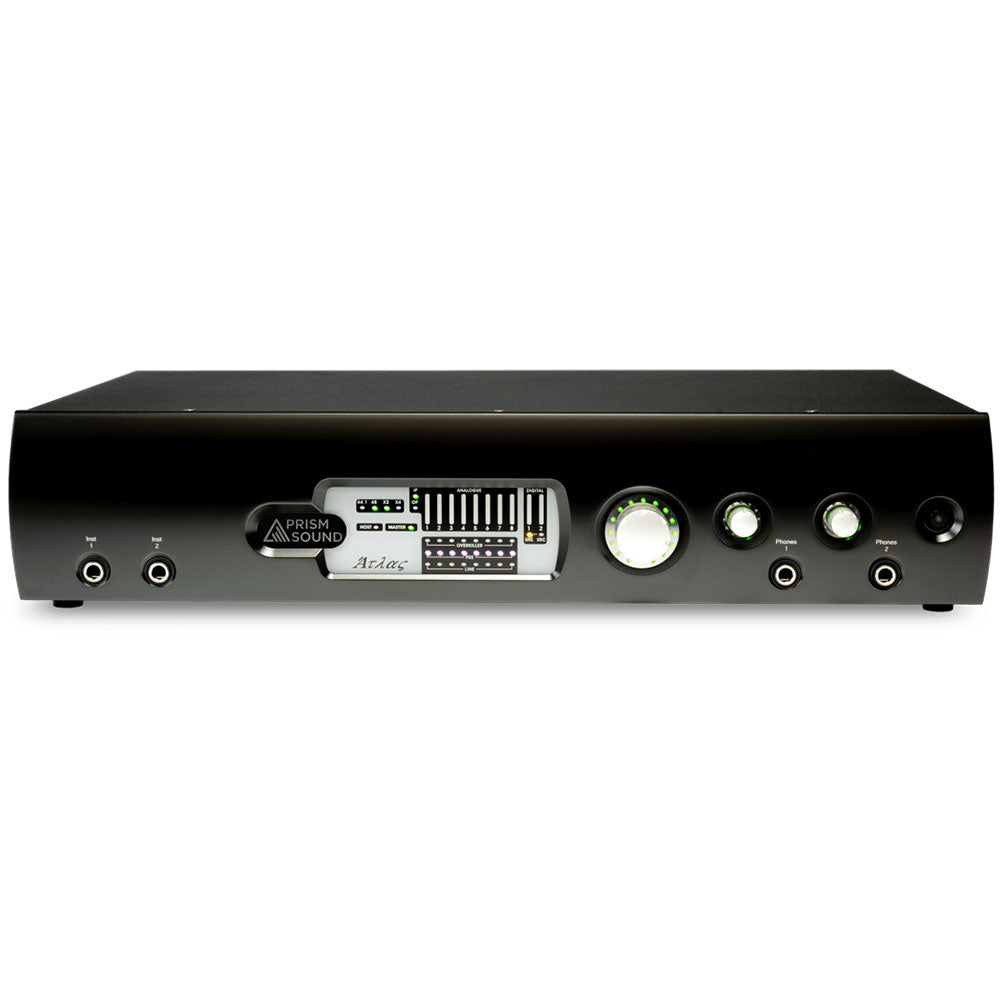
| Front Panel | |
| Instrument Inputs | 2 x 6.3mm mono jack sockets, auto-select to analogue inputs 1 / 2 when plugged |
| Headphone Outputs | 2 x 6.3mm stereo TRS Jacks, each with illuminated volume control |
| Master volume | Assignable encoder / push switch with halo indication |
| Standby button | with standby indicator (also flashes when unit is in 'identify' mode) |
| Indication: | |
| Level Meters | 10 x multi-segment bargraphs with overload indication, 8 for analogue, 2 for digital, assignable to inputs or outputs |
| Input selection | Indicate mode of analogue inputs 1-8 as Mic / line / inst with phantom power indication for mic mode |
| Overkiller | For every analogue input, lit when Overkiller limiters are acting |
| Digital Input | indicators for digital input unlocked and SRC (sample-rate converter) selected |
| Digital Output | indicator for SRC (sample-rate converter) selected |
| Sync | Master indicator, lit when interface is providing system sync |
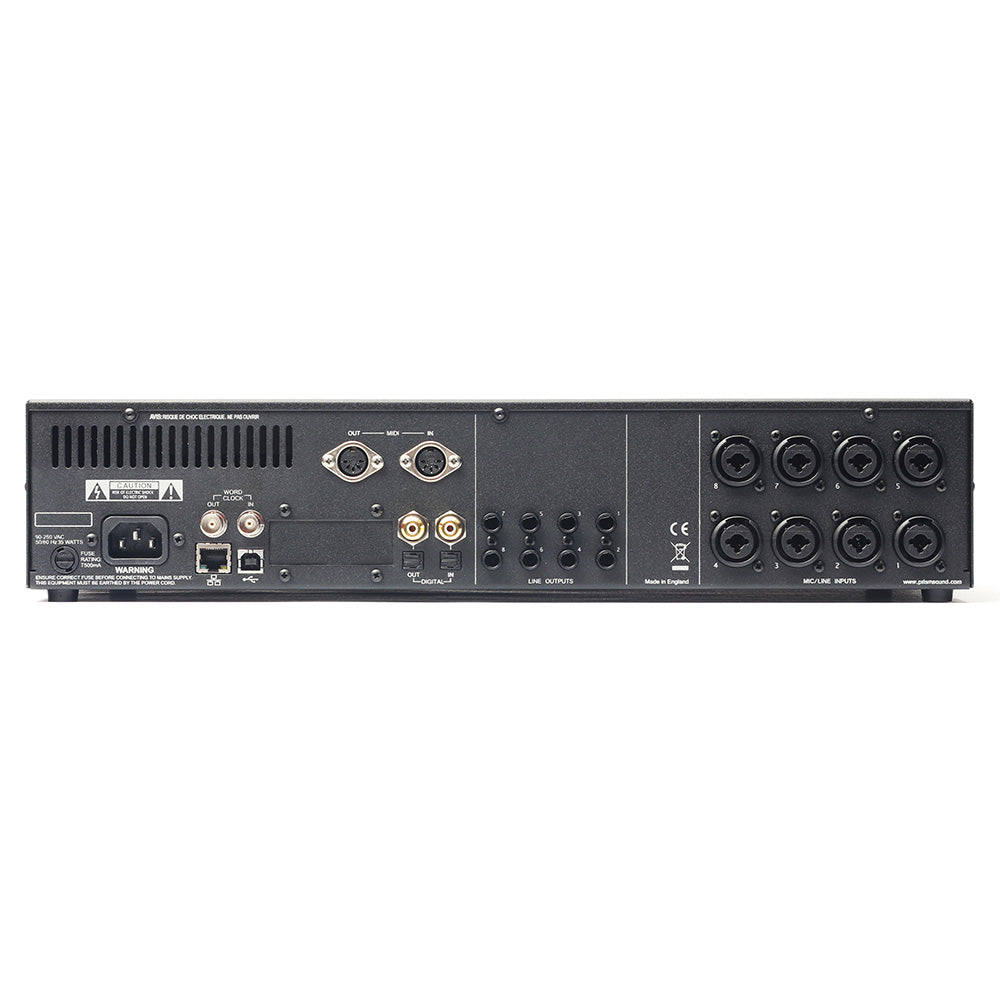
| Rear Panel | |
| Mic / Line inputs | 8 x combo connectors with XLR sockets for mic input and 6.3mm TRS jack sockets for line input (balanced or unbalanced) |
| Line outputs | 8 x 6.3mm TRS jack sockets (balanced or unbalanced) |
| Digital inputs | 1 x RCA 1 x TOSLINK for S/PDIF or ADAT Optical input;Ê (RCA can operate as AES3 input using XLR-RCA adapter supplied) |
| Digital output | 1 x RCA 1 x TOSLINK for S/PDIF or ADAT Optical output;Ê (RCA can operate as AES3 output using XLR-RCA adapter supplied) |
| MIDI I/O | 2 x 5 Pin DIN sockets (in and out) |
| Wordclock | 2 x BNC sockets, output and input (75R) |
| USB port | 1 x USB 2 port |
| Ethernet port | For future expansion / AVB |
| MDIO Expansion Slot | For alternative digital multi-channel I/O |
| Mains power | 3-pin 6A IEC inlet |
| Software Support | |
| Mac OS Support | OS X 10.4 or later, Intel platform |
| Windows OS Support | Windows Vista, 7 or 8, 32 or 64 bit |
| Mac audio driver | Core Audio device |
| Windows audio driver | ASIO device |
| Control Panel applet | Graphical user interface for control of single or multiple Atlas units under Mac OS X or Windows. |
| Analog Line Inputs | |
| Configuration | Electronically balanced, with fully-balanced analogue signal path |
| Input Sensitivity | Switchable '+4dBu' (0dBFS = +18dBu) or '-10dBV' (0dBFS = +6dBu) |
| Input Impedance | 14.5k½ |
| Unbalanced Mode | Automatic |
| Total harmonic distortion | -117dB (0.00014%, -0.1dBFS) |
| THD+N | -111dB (0.00028%, -0.1dBFS) |
| Dynamic Range | 116dB (-60dBFS) |
| Gain Accuracy | ±0.05dB |
| LF roll-off | -0.05dB at 8Hz; -3dB at <1Hz |
| HF roll-off | fs = 44.1kHz: -0.05dB at 21.1kHz; -3dB at 22.0kHz fs = 48kHz: -0.05dB at 23.0kHz; -3dB at 23.9kHz fs = 96kHz: -0.05dB at 32.0kHz; -3dB at 47.9kHz fs = 192kHz: -0.05dB at 32.0kHz; -3dB at 78kHz |
| CMRR | 20Hz..20kHz:>70dB |
| Inter-channel cross-talk | 1kHz: <140dB; 20Hz..20kHz: <-120dB |
| Inter-channel phase | 10Hz..5kHz: ±0.25¡, 5kHz..20kHz: ±1.0¡, 20kHz..50kHz: ±2.0¡, |
| Overkiller | Progessive limiter, auto-aligning, selectable per channel |
| Impact Filter | High-pass filter, -3dB at 80Hz, 40dB/decade (selectable for channels 1-4; whether in line, mic or instrument mode) |
| RIAA de-emphasis filter | Response accuracy: ±0.22dB at fs=44.1kHz; ±0.14dB at fs=48kHz; ±0.015dB at other sample rates |
| M-S matrix | Allows direct connection of mid-side mics, or non-matrix mic-preamps (selectable for channels 1-4; whether in line or mic mode) |
| Microphone Preamplifiers | |
| Configuration | Electronically balanced, with fully balanced analogue signal path |
| Gain | 10dB to 65dB in 1dB steps (0dBFS = -56dBu to -1dBu) |
| Gain accuracy | ±0.05dB |
| Input impedance | 5.5k½ |
| THD | +10dB gain: -116dB at -0.1dBFS (0.00016%) +40dB gain: -110dB at -0.1dBFS (0.00032%) |
| THD+N | +10dB gain: -108dB at -0.1dBFS (0.00040%) |
| Equivalent input noise (EIN) | +30dB gain: -128.5dBu (0½ source); -126.3dBu (150½ source) +40dB gain: -130.9dBu (0½ source); -127.6dBu (150½ source) +50dB gain: -131.2dBu (0½ source); -127.7dBu (150½ source) +60dB gain: -131.4dBu (0½ source); -127.8dBu (150½ source) |
| LF roll-off | -0.05dB at 20Hz, -3dB at 5Hz |
| HF roll-off | As per analogue line input data (dependent on fs) |
| CMRR | 50Hz/60Hz:>110dB at all gains 1kHz:>100dB at all gains 20kHz:>90dB at all gains |
| Phantom power | +48V, switchable per channel |
| Pad | -20dB, switchable per channel |
| Instrument Preamplifiers | |
| Configuration | Unbalanced, high impedance buffer |
| Gain | 10dB to 65dB in 1dB steps, 18dB pad (0dBFS = -38dBu to 17dBu) |
| Gain accuracy | ±0.05dB |
| Input impedance | 1M½ |
| Analog Outputs | |
| Configuration | Electronically balanced, with fully-balanced analogue signal path |
| Output amplitude | Switchable '+4dBu' (0dBFS = +18dBu) or '-10dBV (0dBFS = +6dBu) |
| Output impedance | 100½ balanced, 50½ unbalanced |
| Unbalanced mode | Automatic, with bootstrapping level compensation |
| Total harmonic distortion | -107dB (0.00045%, -1dBFS) |
| THD+N | -106dB (0.00050%, -0.1dBFS) |
| Dynamic range | 115dB (-60dBFS) |
| Gain accuracy | ±0.05dB |
| LF roll-off | -0.05dB at 8Hz, -3dB at <1Hz |
| HF roll-off | fs = 44.1kHz: -0.05dB at 21.4kHz; -3dB at 22.0kHz fs = 48kHz: -0.05dB at 23.2kHz; -3dB at 23.9kHz fs = 96kHz: -0.05dB at 32.0kHz; -3dB at 47.8kHz fs = 192kHz: -0.05dB at 32.0kHz; -3dB at 76kHz |
| Output balance | >50dB |
| Inter-channel cross-talk | 1kHz: <135dB; 20Hz..20kHz: <-120dB |
| Inter-channel phase | 10Hz..5kHz: ±0.4¡, 5kHz..20kHz: ±0.25¡, 20kHz..50kHz: ±0.5¡, |
| Digital Inputs | |
| Formats supported | S/PDIF (RCA or TOSLINK), ADAT, ADAT S/MUX (TOSLINK) |
| Sample rates supported | S/PDIF (2 channel): 44.1, 48, 88.2, 96, 176.4 and 192kHz ADAT (8 channel) 44.1 and 48kHz ADAT S/MUX (4 channel): 88.2 and 96kHz |
| Channel Status | ignored |
| Word-length | 24 bit |
| AES3 operation | via S/PDIF RCA, using RCA-XLR adaptor (supplied) |
| Sample-rate converter (SRC) | Selectable at S/PDIF input; allowing input at any sample rate |
| Bit transparency | Maintained (allows recording of Dolby or DTS streams) |
| Digital Outputs | |
| Formats supported | S/PDIF (RCA or TOSLINK), ADAT, ADAT S/MUX (TOSLINK) |
| Sample rates supported | S/PDIF (2 channel): 44.1, 48, 88.2, 96, 176.4 and 192kHz ADAT (8 channel) 44.1 and 48kHz ADAT S/MUX (4 channel): 88.2 and 96kHz |
| Channel Status | Full implementation, Consumer (S/PDIF) or professional (AES3) |
| Word-length | 24 bit, or reduction to 16 bits using flat TPDF dither or Prism Sound SNS (Super Noise Shaping - four alternative shapes available) |
| AES3 operation | via S/PDIF RCA, using RCA-XLR adaptor (supplied) |
| Sample-rate converter (SRC) | Selectable at S/PDIF output; output rate can be referenced to Wordclock, DI or local clock at 44.1, 48, 88.2, 96, 176.4 or 192kHz |
| Bit transparency | Maintained in 24 bit mode (allows playback of Dolby or DTS streams to external decoder) |
| Synchronization | |
| System sample rates | 44.1 / 48 / 88.2 / 96 / 176.4 / 192kHz |
| Sync sources: | |
| Master | local, Wordclock, DI (S/PDIF input) or ADAT |
| Slave | bus master (another interface or Host computer) |
| Local clock accuracy | ±50ppm |
| Jitter rejection | >60dB / decade above 100Hz |
| Internal mixer delay (total analogue in to out) |
fs = 44.1kHz: 0.56ms; fs = 48kHz: 0.52ms; fs = 88.2kHz: 0.2ms; fs = 96kHz: 0.18ms; fs = 176.4kHz: 0.09ms; fs = 192kHz: 0.08ms; |
| Physical | |
| Form factor | 2u 19inch rack mountableÊ (rubber feet and rack ears supplied) |
| Dimensions | Table top (inc feet): W: 440mm D: 290mm H: 95mm Rack-mount (inc ears): W: 483mm D: 290mm H: 88mm (2u) |
| Power: | 90-250VAC, 50/60Hz internal power supply IEC 6A connector |
| Power consumption | 35W |
| Fuse rating | 0.5A(T), 20mm, ceramic |
| Weight: | 5kg |
| Operation ambient conditions | 0 to 35¡C, 85% maximum relative humidity |
| Supplied Accessories | |
| Printed manual | x 1 |
| Software CD | x 1 |
| IEC mains lead | x 1 |
| 19" Rackmount ears | x 2 (pair) |
| Allen key (for rack ears) | x 1 |
| USB lead | x 1 |
| XLR-F to RCA-M adaptor (S/PDIF/AES3) |
x 1 |
| XLR-M to RCA-M adaptor (S/PDIF/AES3) |
x 1 |
Atlas is a USB multi-track audio interface for personal recording and sound production, for professional musicians, songwriters, engineers and producers as well as recording studios, post production facilities and scoring stages. Atlas is ideal for music and sound recording, mixing, multitracking, overdubbing, stem-based mastering, analogue summing and critical listening applications.
Signal path
Atlas provides Prism Sound's renowned performance, sound quality and state-of-the-art clock technology in a dedicated unit compatible with both Windows (Vista and higher, 32 and 64 bit) as well as Mac OS X 10.5 and later (Intel). Once configured with a computer, Atlas can also operate stand-alone using its ADAT, S/PDIF or AES3 I/O.
Eight analogue input channels and up to 10 digital input channels are available as inputs for your audio workstation software through the host computer's audio driver. Similarly, eight analogue output channels, up to 10 digital output channels and stereo headphone outputs can play 20 different channels. For low-latency foldback or monitoring to headphones or main outputs, each output pair (1-2, 3-4 etc or the headphone output) can optionally be driven from the built-in DSP mixer with an individual local mix of any selection of inputs through the controller applet. All analogue inputs are electronically balanced with automatic unbalanced operation. Analogue outputs are electronically balanced with 'bootstrapping', i.e. level is maintained if one leg is grounded.
Verifile
Verifile is a radical new proprietary technology exclusive to Prism Sound which allows computer audio streams and recorded files to be quickly checked for a wide range of clicks, errors and dropouts, without any compromise in the audio content or any additional metadata.
Verifile is a solution to the issues of reliability that have plagued critical recording projects ever since the adoption of computer recording of audio. Typically, general purpose computers whether Mac, PC or other OS, are designed to perform a wide range of simultaneous tasks of which audio recording is just one. Even if the user would like audio recording to be given top priority, the computer's operating system is not designed that way, and (even if optimally configured, which they seldom are) it will, now and again, interrupt audio recording to do something else. This is especially true when dealing with many channels of high resolution audio, perhaps with low latency, which needs a continuous high data throughput. The result is usually a recorded 'dropout' of some kind: anyone who has recorded audio on a computer is familiar with repeated or missed samples or entire sections, random clicks, pops - even channel swapping.
Verifile is a 'fragile steganographic' process which embeds derivative data within the dither of the ADC, containing a rolling hash code which allows the audio data to be thoroughly and continuously checked. Recovery of this data from the audio stream or file enables verification that the stream or file contains exactly the audio data that was produced by the ADC at the time of recording. Any incorrect samples, missing or repeated audio segments or any other audio errors in the resulting files can be reliably detected, providing complete confidence that the recorded file is error-free.
Processing of any kind of a Verifile recording such as EQ, level changes, additional re-dithering, sample-rate conversion etc will result in a failure to decode the rolling hash code in the dither and hence indicate that the recording is not an original.
No-compromise, full Prism Sound audio quality
Atlas makes no compromises on audio quality. It is the result of years of research and development into digital audio conversion and extensive dialogue with Prism Sound's customers.
Atlas draws on Prism Sound's years of experience in developing digital audio products, including its range of audio test equipment, adopted by a wide variety of clients across the audio industry from pro-audio to consumer electronics. This experience means that Atlas is well-behaved both as a computer peripheral and an audio processor.
Reliability is vitally important in professional recording. Prism Sound has always made extensive use of precise software calibration techniques in its converters - pots and tweaks are always unreliable, so there are none.
The design team has gone to great lengths to minimise noise and interference, in particular hum. All of the analogue circuits have galvanic isolation, while the unit's electronically balanced I/O allows it to handle common mode interference sources as well as enabling trouble-free connection to unbalanced equipment.
It is often said that THD+N figures do not always correlate well with the perception of sound quality and this is true - partly because the traditional measures of THD+N or SINAD expressed as RMS figures are rather a broad measure. With this in mind, we have taken great care to make sure that not only is the Atlas noise and distortion spectrum beyond reproach, but the RMS distortion result measures up to the state of the art.
Standards compliant USB interface
Prism Sound has taken on board the increasing importance of native processing power for professional users and the fact that software products for standard PC and Mac platforms have been greatly enhanced in recent years. Atlas uses a USB2 interface. This is a UAC2 (USB Audio Class 2) interface supported natively in Mac, iPad, Linux and Android, and in Windows via a driver.
Atlas is easy to connect to your computer and to your outboard gear. For both Mac and PC platforms, there is a controller application to configure the unit and control its built-in mixer and other functions. Aside from the monitor and headphone level controls, everything else is operated solely from the Atlas controller application. The controller software opens on-screen as a separate panel alongside your existing editing software.
Multichannel Digital Input and Output (MDIO) expansion
Atlas & Titan support Prism Sound's MDIO expansion cards, which provide alternative "host" connections. The "host" is usually a computer and the Atlas or Titan interface provides a means of connection between the host and the external analogue and digital audio I/O ports.
Without the MDIO expansion card fitted, the host connection would always be the default USB connection.
The MDIO expansion slot provides an alternative host connection. It does not necessarily disable the USB port, but in the case of the Pro Tools interface MDIO-PTHDX, the USB port is switched off when the Pro Tools interface is to be used.
Currently, only the MDIO-PTHDX expansion card is available. Others may be produced later.
Flexible Inputs and Outputs
Many professional users wanted a highly integrated solution with instrument and microphone inputs, and line outputs that could be used for stereo or multi-channel monitoring and/or foldback to performers. Atlas offers eight analogue recording channels, eight monitoring outputs, stereo digital input and output on a phono connector plus concurrent optical digital I/O ports that can interface to S/PDIF or ADAT data formats, giving Atlas a maximum capability of 18 concurrent input and output channels plus stereo headphones.
Atlas's eight analogue inputs support various capabilities. Atlas has eight high-grade microphone pre-amps with software-controlled gain in 1dB steps, individually-switchable phantom power, 20dB pads - and very low noise and distortion. These combo connector inputs support both microphone and line input, with digitally-controlled mic gain in excess of 60dB. Two front panel inputs also support direct injection (DI) instrument connections with quarter-inch jacks. RIAA Equalization can be selected in the controller applet on channels 1 & 2 so that turntables can be connected for archiving or sampling applications. By selecting the input type (Mic or DI) , low- or high-impedance cartridges can be loaded with suitable termination impedances. All analogue inputs have individually-selectable Prism Sound "Overkillers" built in, just as on the higher-priced ADA-8XR, to catch those fast transients. The Overkiller threshold automatically follows the operating line-up level selection (+4dBu or -10dBV). Overkillers are ideal for percussive sounds, particularly drums, where headroom can be a problem.
The co-axial digital I/O port can be switched in the Atlas controller applet between S/PDIF and AES3 formats. This control changes the operating voltage and the Channel Status format and is complemented by two in-line adaptor leads that provide external XLR connections for AES3 devices. Other connections include wordclock sync I/O.
Atlas can also operate in a stand-alone mode using its ADAT or co-axial digital I/O connections. Once set up using the Atlas controller applet, the unit can be disconnected from the host computer and used independently. Atlas will retain its settings when powered down so even if it is switched off, Atlas can be re-powered and stand-alone operation can continue with the automatically-stored settings.
| Front Panel | |
| Instrument Inputs | 2 x 6.3mm mono jack sockets, auto-select to analogue inputs 1 / 2 when plugged |
| Headphone Outputs | 2 x 6.3mm stereo TRS Jacks, each with illuminated volume control |
| Master volume | Assignable encoder / push switch with halo indication |
| Standby button | with standby indicator (also flashes when unit is in 'identify' mode) |
| Indication: | |
| Level Meters | 10 x multi-segment bargraphs with overload indication, 8 for analogue, 2 for digital, assignable to inputs or outputs |
| Input selection | Indicate mode of analogue inputs 1-8 as Mic / line / inst with phantom power indication for mic mode |
| Overkiller | For every analogue input, lit when Overkiller limiters are acting |
| Digital Input | indicators for digital input unlocked and SRC (sample-rate converter) selected |
| Digital Output | indicator for SRC (sample-rate converter) selected |
| Sync | Master indicator, lit when interface is providing system sync |
| Rear Panel | |
| Mic / Line inputs | 8 x combo connectors with XLR sockets for mic input and 6.3mm TRS jack sockets for line input (balanced or unbalanced) |
| Line outputs | 8 x 6.3mm TRS jack sockets (balanced or unbalanced) |
| Digital inputs | 1 x RCA 1 x TOSLINK for S/PDIF or ADAT Optical input;Ê (RCA can operate as AES3 input using XLR-RCA adapter supplied) |
| Digital output | 1 x RCA 1 x TOSLINK for S/PDIF or ADAT Optical output;Ê (RCA can operate as AES3 output using XLR-RCA adapter supplied) |
| MIDI I/O | 2 x 5 Pin DIN sockets (in and out) |
| Wordclock | 2 x BNC sockets, output and input (75R) |
| USB port | 1 x USB 2 port |
| Ethernet port | For future expansion / AVB |
| MDIO Expansion Slot | For alternative digital multi-channel I/O |
| Mains power | 3-pin 6A IEC inlet |
| Software Support | |
| Mac OS Support | OS X 10.4 or later, Intel platform |
| Windows OS Support | Windows Vista, 7 or 8, 32 or 64 bit |
| Mac audio driver | Core Audio device |
| Windows audio driver | ASIO device |
| Control Panel applet | Graphical user interface for control of single or multiple Atlas units under Mac OS X or Windows. |
| Analog Line Inputs | |
| Configuration | Electronically balanced, with fully-balanced analogue signal path |
| Input Sensitivity | Switchable '+4dBu' (0dBFS = +18dBu) or '-10dBV' (0dBFS = +6dBu) |
| Input Impedance | 14.5k½ |
| Unbalanced Mode | Automatic |
| Total harmonic distortion | -117dB (0.00014%, -0.1dBFS) |
| THD+N | -111dB (0.00028%, -0.1dBFS) |
| Dynamic Range | 116dB (-60dBFS) |
| Gain Accuracy | ±0.05dB |
| LF roll-off | -0.05dB at 8Hz; -3dB at <1Hz |
| HF roll-off | fs = 44.1kHz: -0.05dB at 21.1kHz; -3dB at 22.0kHz fs = 48kHz: -0.05dB at 23.0kHz; -3dB at 23.9kHz fs = 96kHz: -0.05dB at 32.0kHz; -3dB at 47.9kHz fs = 192kHz: -0.05dB at 32.0kHz; -3dB at 78kHz |
| CMRR | 20Hz..20kHz:>70dB |
| Inter-channel cross-talk | 1kHz: <140dB; 20Hz..20kHz: <-120dB |
| Inter-channel phase | 10Hz..5kHz: ±0.25¡, 5kHz..20kHz: ±1.0¡, 20kHz..50kHz: ±2.0¡, |
| Overkiller | Progessive limiter, auto-aligning, selectable per channel |
| Impact Filter | High-pass filter, -3dB at 80Hz, 40dB/decade (selectable for channels 1-4; whether in line, mic or instrument mode) |
| RIAA de-emphasis filter | Response accuracy: ±0.22dB at fs=44.1kHz; ±0.14dB at fs=48kHz; ±0.015dB at other sample rates |
| M-S matrix | Allows direct connection of mid-side mics, or non-matrix mic-preamps (selectable for channels 1-4; whether in line or mic mode) |
| Microphone Preamplifiers | |
| Configuration | Electronically balanced, with fully balanced analogue signal path |
| Gain | 10dB to 65dB in 1dB steps (0dBFS = -56dBu to -1dBu) |
| Gain accuracy | ±0.05dB |
| Input impedance | 5.5k½ |
| THD | +10dB gain: -116dB at -0.1dBFS (0.00016%) +40dB gain: -110dB at -0.1dBFS (0.00032%) |
| THD+N | +10dB gain: -108dB at -0.1dBFS (0.00040%) |
| Equivalent input noise (EIN) | +30dB gain: -128.5dBu (0½ source); -126.3dBu (150½ source) +40dB gain: -130.9dBu (0½ source); -127.6dBu (150½ source) +50dB gain: -131.2dBu (0½ source); -127.7dBu (150½ source) +60dB gain: -131.4dBu (0½ source); -127.8dBu (150½ source) |
| LF roll-off | -0.05dB at 20Hz, -3dB at 5Hz |
| HF roll-off | As per analogue line input data (dependent on fs) |
| CMRR | 50Hz/60Hz:>110dB at all gains 1kHz:>100dB at all gains 20kHz:>90dB at all gains |
| Phantom power | +48V, switchable per channel |
| Pad | -20dB, switchable per channel |
| Instrument Preamplifiers | |
| Configuration | Unbalanced, high impedance buffer |
| Gain | 10dB to 65dB in 1dB steps, 18dB pad (0dBFS = -38dBu to 17dBu) |
| Gain accuracy | ±0.05dB |
| Input impedance | 1M½ |
| Analog Outputs | |
| Configuration | Electronically balanced, with fully-balanced analogue signal path |
| Output amplitude | Switchable '+4dBu' (0dBFS = +18dBu) or '-10dBV (0dBFS = +6dBu) |
| Output impedance | 100½ balanced, 50½ unbalanced |
| Unbalanced mode | Automatic, with bootstrapping level compensation |
| Total harmonic distortion | -107dB (0.00045%, -1dBFS) |
| THD+N | -106dB (0.00050%, -0.1dBFS) |
| Dynamic range | 115dB (-60dBFS) |
| Gain accuracy | ±0.05dB |
| LF roll-off | -0.05dB at 8Hz, -3dB at <1Hz |
| HF roll-off | fs = 44.1kHz: -0.05dB at 21.4kHz; -3dB at 22.0kHz fs = 48kHz: -0.05dB at 23.2kHz; -3dB at 23.9kHz fs = 96kHz: -0.05dB at 32.0kHz; -3dB at 47.8kHz fs = 192kHz: -0.05dB at 32.0kHz; -3dB at 76kHz |
| Output balance | >50dB |
| Inter-channel cross-talk | 1kHz: <135dB; 20Hz..20kHz: <-120dB |
| Inter-channel phase | 10Hz..5kHz: ±0.4¡, 5kHz..20kHz: ±0.25¡, 20kHz..50kHz: ±0.5¡, |
| Digital Inputs | |
| Formats supported | S/PDIF (RCA or TOSLINK), ADAT, ADAT S/MUX (TOSLINK) |
| Sample rates supported | S/PDIF (2 channel): 44.1, 48, 88.2, 96, 176.4 and 192kHz ADAT (8 channel) 44.1 and 48kHz ADAT S/MUX (4 channel): 88.2 and 96kHz |
| Channel Status | ignored |
| Word-length | 24 bit |
| AES3 operation | via S/PDIF RCA, using RCA-XLR adaptor (supplied) |
| Sample-rate converter (SRC) | Selectable at S/PDIF input; allowing input at any sample rate |
| Bit transparency | Maintained (allows recording of Dolby or DTS streams) |
| Digital Outputs | |
| Formats supported | S/PDIF (RCA or TOSLINK), ADAT, ADAT S/MUX (TOSLINK) |
| Sample rates supported | S/PDIF (2 channel): 44.1, 48, 88.2, 96, 176.4 and 192kHz ADAT (8 channel) 44.1 and 48kHz ADAT S/MUX (4 channel): 88.2 and 96kHz |
| Channel Status | Full implementation, Consumer (S/PDIF) or professional (AES3) |
| Word-length | 24 bit, or reduction to 16 bits using flat TPDF dither or Prism Sound SNS (Super Noise Shaping - four alternative shapes available) |
| AES3 operation | via S/PDIF RCA, using RCA-XLR adaptor (supplied) |
| Sample-rate converter (SRC) | Selectable at S/PDIF output; output rate can be referenced to Wordclock, DI or local clock at 44.1, 48, 88.2, 96, 176.4 or 192kHz |
| Bit transparency | Maintained in 24 bit mode (allows playback of Dolby or DTS streams to external decoder) |
| Synchronization | |
| System sample rates | 44.1 / 48 / 88.2 / 96 / 176.4 / 192kHz |
| Sync sources: | |
| Master | local, Wordclock, DI (S/PDIF input) or ADAT |
| Slave | bus master (another interface or Host computer) |
| Local clock accuracy | ±50ppm |
| Jitter rejection | >60dB / decade above 100Hz |
| Internal mixer delay (total analogue in to out) |
fs = 44.1kHz: 0.56ms; fs = 48kHz: 0.52ms; fs = 88.2kHz: 0.2ms; fs = 96kHz: 0.18ms; fs = 176.4kHz: 0.09ms; fs = 192kHz: 0.08ms; |
| Physical | |
| Form factor | 2u 19inch rack mountableÊ (rubber feet and rack ears supplied) |
| Dimensions | Table top (inc feet): W: 440mm D: 290mm H: 95mm Rack-mount (inc ears): W: 483mm D: 290mm H: 88mm (2u) |
| Power: | 90-250VAC, 50/60Hz internal power supply IEC 6A connector |
| Power consumption | 35W |
| Fuse rating | 0.5A(T), 20mm, ceramic |
| Weight: | 5kg |
| Operation ambient conditions | 0 to 35¡C, 85% maximum relative humidity |
| Supplied Accessories | |
| Printed manual | x 1 |
| Software CD | x 1 |
| IEC mains lead | x 1 |
| 19" Rackmount ears | x 2 (pair) |
| Allen key (for rack ears) | x 1 |
| USB lead | x 1 |
| XLR-F to RCA-M adaptor (S/PDIF/AES3) |
x 1 |
| XLR-M to RCA-M adaptor (S/PDIF/AES3) |
x 1 |
Your home for all things pro audio—backed by expertise and experience. Connect with us today.
Your home for all things pro audio—backed by expertise and experience. Connect with us today.