

Clear-Com HXII-RM-X4 - Speaker Station for HelixNet Intercom (XLR4M)
Availability:
Special Order ItemThis item is not stocked and needs to be ordered from the manufacturer. Please contact our sales team for more information.
Description
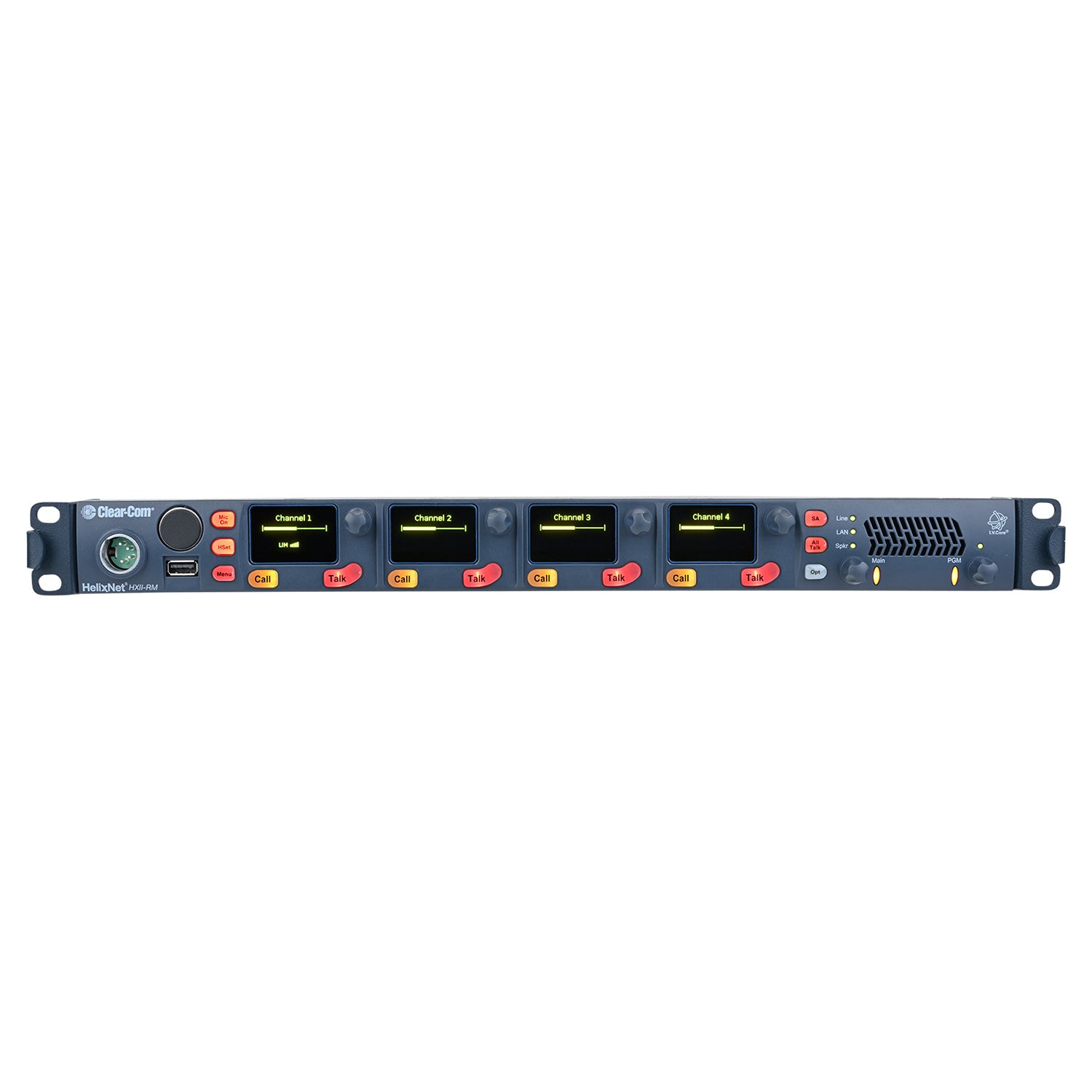
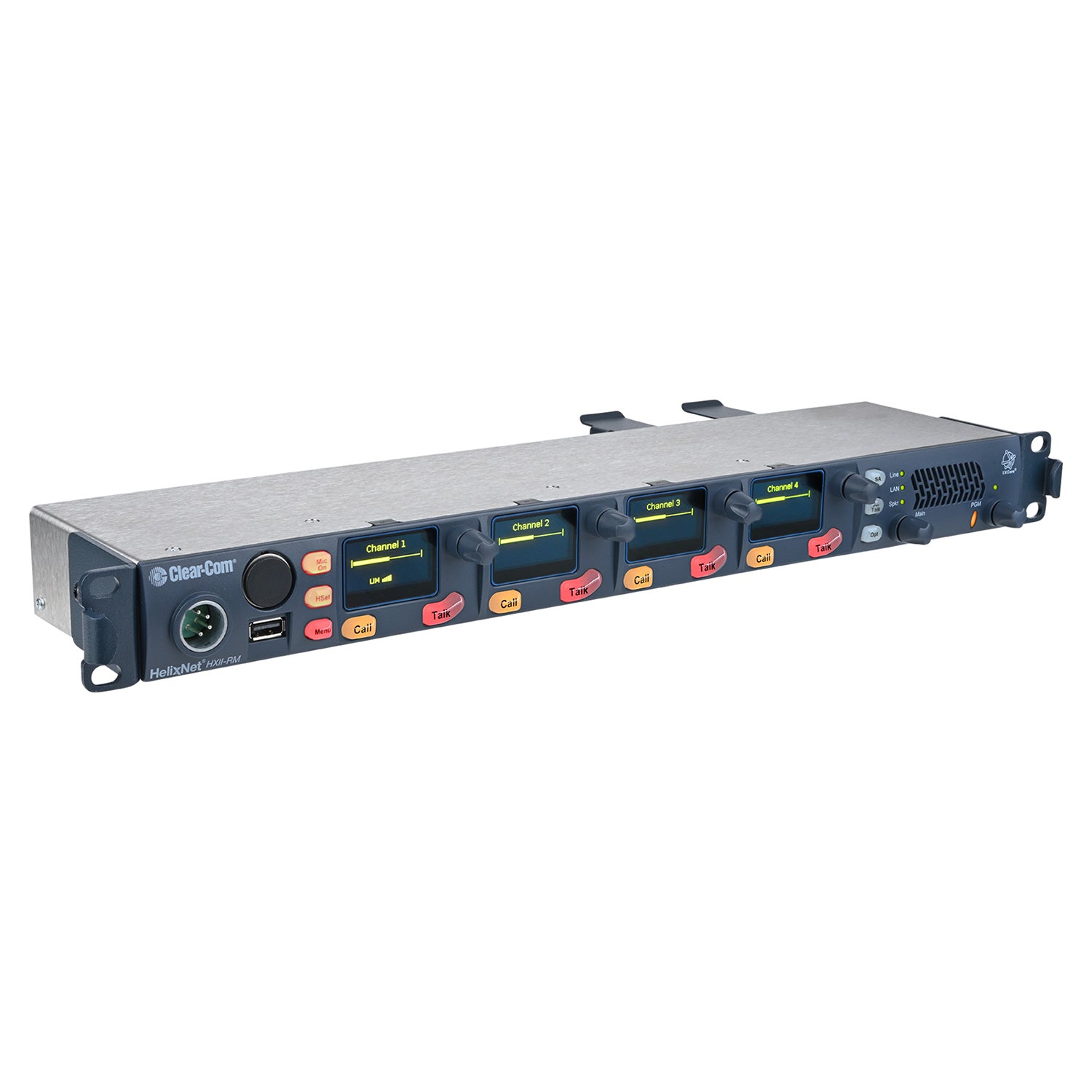
The HelixNet Remote Station HXII-RM is a 1RU 4-channel intercom user station with utility connections for Program Audio input and Stage Announce output, hosted by Arcadia¨ Central Station or HelixNet HMS-4X main station.
Features:
- Easy to use front panel with OLED displays and backlit keys
- Headset or hands-free support with speaker and mic
- 4 Keysets assignable to channels
- All Talk, Stage Announce, RMK and Program Audio level control
- Expansion mode for 8-24 channels
- Ethernet Network port with PoE
- Powerline loop-through on XLR
- Program Audio input
- Stage Announce output
- Contact closure input output
- Easy to use CCM browser configuration
- Fast front panel control / configuration
- Central discovery / pairing on Arcadia
- Plug-and-go Powerline
- Central firmware upgrades from host
HelixNet System
- Wired Partyline - Networked
- Hosted by Arcadia or HMS-4X
- Up to 24 Channels Ð Licensed
- Up to 64 or 128 HelixNet Endpoints
- Program Audio user level control
User Station
The innovative front panel user station provides four keysets assignable to any intercom channel. The user station is provisioned with a headset connection, gooseneck mic connector and a loudspeaker in addition to All Call, Stage Announce, Remote Mic Kill and Program Audio level controls. Expansion mode allows up to six remote stations (or HMS in non-Arcadia systems) networked user stations to be combined, for a unified user station with up to 24 channels.
Local and Central Management Options
HelixNet Remote Station can be added to an Arcadia or legacy HMS-4X without central configuration or interruption. Front panel keysets form unique waterfall menus allowing tactile device configuration and channel assignments. Roles can be created and applied to one or multiple remote stations remotely or locally. Roles can be edited locally or centrally managed from the Core Configuration Manager (CCM1).
Connectivity and Power Options
HelixNet Remote Station connects to Arcadia Central Station or HelixNet HMS-4X main station with HLI-ET2 Ethernet module over network. Power can be supplied to the HelixNet Remote Station locally with a supplied power supply or Power over Ethernet (PoE) from 3rd party devices. Alternatively, the HelixNet remote station can connect using XLR Powerline, with power or locally powered, to the Arcadia Central Station via HXII-DPL Powerline Device or to HelixNet HMS-4X main stations.
| HelixNet System Hosts | Arcadia: Supports up to 128 HelixNet User Stations over Ethernet or Powerline via the HXII-DPL Powerline Device. Up to 24 Channels can be HelixNet Enabled using a Licensed Port for assignment to any HelixNet User Station keyset. HMS-4X: Supports up to 64 endpoints (Remote Stations, Speaker Stations, Beltpacks, HLI-2W2, HLI-4W2, LQ port). User stations can connect directly to the 2 HMS-4X Powerlines or via optional HLI-ET2 module using HXII-DPL Powerline Device or 3rd party network switch connection. HMS allows use of 12 channels which can be expanded to 24 using optional license. |
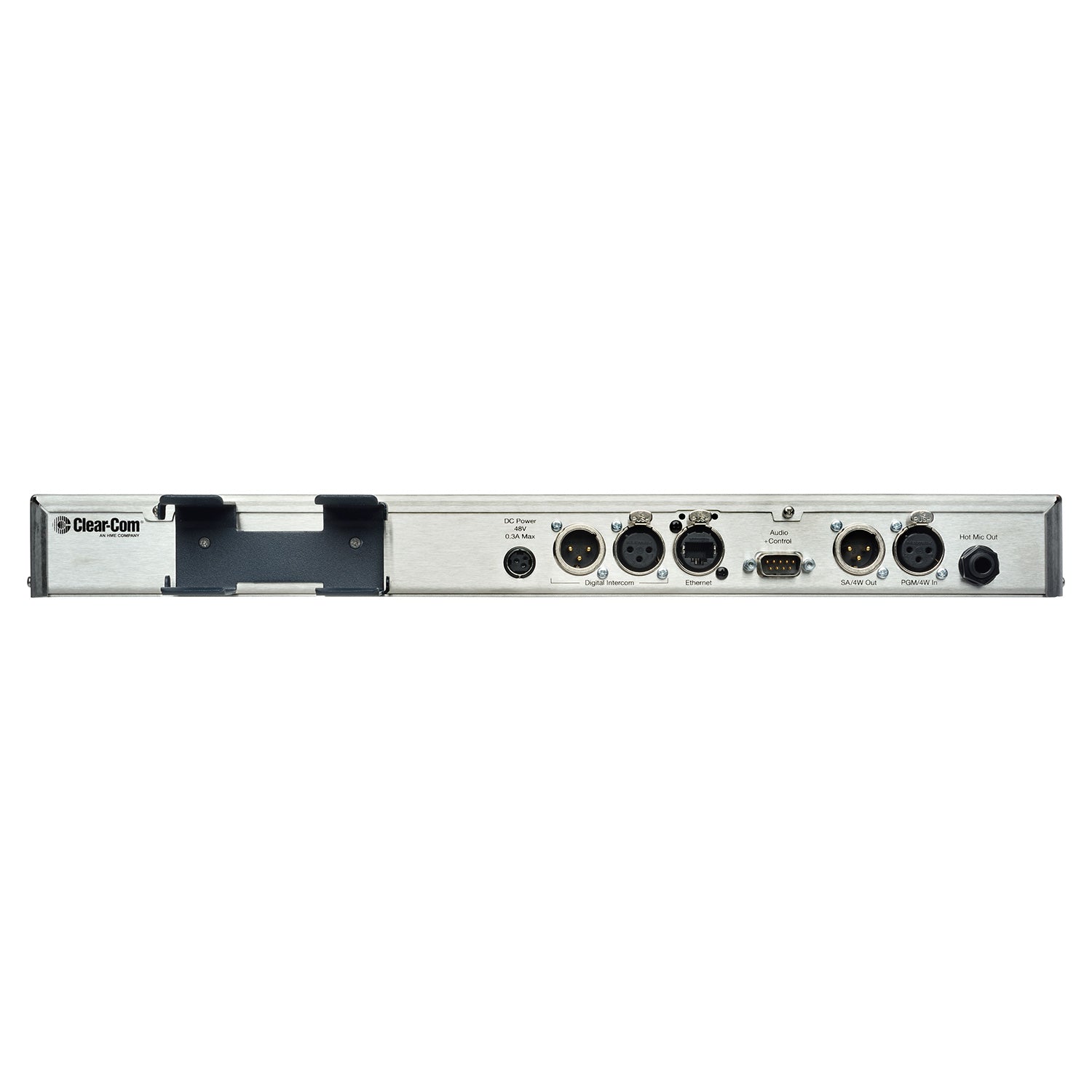
| Connectors | XLR Powerline: 3-pin XLR-M/F Ethernet/PoE: EtherCON RJ45 Headset: 4-pin XLRÐM Gooseneck Mic: 3-pin Tuchel Program Audio: 3-pin XLRÐF Stage Announce: 3-pin XLRÐM Hot Mic/IFB Interface: 1/4\" (0.64 cm) TRS jack GPIO: 9-pin D-type male (1xGPI, 1xGPO) USB: Type A DC Power: 3-pin KPJX-PM-3-S |
| Microphone Pre-amplifier | Headset Mic Impedance: 200½ (Dynamic) Headset Mic Voltage: 1.7V (Electret selectable) Limiter: +23dB |
| Route to 4-wire output at 0dBu out | Mic Gain: 60dB (Dynamic), 45dB (Electret) Frequency Response: 300Hz Ð 10 kHz ±3dB, contoured for intelligibility Distortion: <0.2% THD @ 1kHz Noise: <-55dBu (Dynamic),<-65dBu (Electret) |
| Headphone Amplifier | Load Impedance: >32½ Output Level: +12dBu before clipping Sidetone: -12dB (selectable) |
| Route from a 4-wire input at 0dBu in | Max Gain: 0dB Frequency Response: 40Hz Ð 10kHz +3dB Distortion: <0.1% THD @ 1kHz Noise: <-65dBu Headphone Limiter: 0dB (selectable) |
| Loudspeaker Amplifier | Load Impedance: 8½ Output Level: +18dBu before clipping |
| Route from a 4-wire input at 0dBu in | Max Gain: 18dB Frequency Response: 200Hz - 10kHz ±3dB Distortion: <0.1% THD @ 1kHz Noise: <-50dBu |
| Program Audio Line Input | Arcadia System Host: Local Listen Only HMS-4X System Host: Local or Channel Assignable. |
| Maximum Level Before Clipping | +18dBu |
| Nominal Input Level | 0dBu (selectable) |
| Input Impedance | >= 10K½ |
| Route to 4-wire output at 0dBu out | Frequency Response: 20Hz - 10kHz ±3dB Distortion: <0.2% THD @ 1kHz Noise: <-65dBu |
| Stage Announce Output | Arcadia System Host: Local SA or Channel Assignable from front panel or Role HMS-4X System Host: Local SA or Channel Assignable |
| Maximum Level Before Clipping | 18dBu |
| Nominal Output Level | 0dBu (selectable) |
| Output Impedance | <= 100½ |
| Route from a dynamic headset | Frequency Response: 300Hz - 12kHz ±3dB Distortion: <0.1% THD @ 1kHz Noise: <-55dBu |
| Hot Mic Output | Maximum Level Before Clipping: +12dBu Nominal Output Level: 0dBu (selectable) Output Impedance: <= 100½ |
| Route from a dynamic headset | Frequency Response: 300Hz - 12kHz ±3dB Distortion: <0.2% THD @ 1kHz Noise: <-55dBu |
| Logic Inputs -GPI | Assignable to talk, call, mic and headset keys |
| Input | 1 |
| Style | Powered input, close contact to ground |
| Detection Voltage (Min) | 3V |
| Input Voltage (Max) | 5V |
| Output Voltage | 5V |
| Output Current (Max) | 1mA |
| Logic Outputs Ð GPO/Relay | Assignable to talk, call, SA keys and channel events |
| Outputs | 1 |
| Style | Power Relay |
| Normalized | Open or Closed, separate pins |
| Switching Voltage (Max) | 30V |
| Switching Current (Max) | 2A |
| Power | |
| Voltage | 48V DC |
| Current (Max) | 0.3A |
| Power (Max) | 14.4W |
| BTU (Max) | 49BTU/hr |
| Input Power Connector | KPJX-PM-3-S |
| This unit can be powered via | |
| AC Adapter - Inline | Input Voltage Range: 100 - 240V AC Input Frequency Range: 50 - 60Hz Input Power Connector: IEC-C14 Output Voltage: 48V DC Output Power (Max): 15W Output Power Connector: KPPX-3-P |
| PoE - Power over Ethernet | IEEE 802.3af-2003 - Class 0 PSE: 15.4W DC max @ Power Source Req. PD: 12.95W DC max @ Powered Device Draw |
| Powerline | Input Voltage: ±29.5V DC Input Current (Speaker Off): 0.3A Input Current (Max): 0.5A |
| Powerline Utilization | Remote Station (Local Power) = 1 beltpack Remote Station (Speaker Off) = 2 beltpacks Remote Station (Speaker On) = 3 beltpacks Note the maximum Powerline capacity of the HMS-4X. Use HelixNet Cable Calculator to validate load and cable distance. |
| Environmental | |
| Temperature | 32¼ - +104¼F (0 - +40¼C) |
| Humidity | 90% relative humidity |
| Physical | |
| Dimensions | 1RU, 1.75 x 19 x 6.4in (HxWxD) (44 x 483 x 165mm) |
| Weight | 4lbs (1.8kg) |
| Network Specifications (Firmware Version 4.5+) | |
| Network Protocols | Ethernet IPv4ÐUnicast Audio and Control mDNSÐMulticast Device Discovery Layer 3 routable with mDNS function limitations HTTPÐManagement I.V. CoreÐDecentralized Network Routing & Mixing IVP-Proprietary intercom Audio and Control WavPackÐAudio Codec |
| Network Ports | Unicast: Port 80 TCPÐSystem Management, Expansion Port 6001 TCPÐSystem Management Port 6001 UDPÐAudio Streams Multicast: Port 5353 UDPÐmDNS, Names, Discovery, Linking, Expansion Optional for device names and linking Mandatory for expansion mode |
| Network Parameters | HMS-4X Endpoint Resource Use: 1-3 |
| Bandwidth | 300-600 (max) kbps from Remote Station to Arcadia/HMS-4X dependent on use of Program Audio Input 1200-2400 (max) kbps from Arcadia/HMS-4X to Remote Station dependent on use of Stage Announce Output |
| Network Jitter Tolerance | <= 128ms jitter buffer per audio stream receiver automatically adjusted to network performance |
| QoS Tags | DSCP=34, Assured Forwarding (AF=41) |
| Link-Local Default IP Address Range | 169.254.0.0/16 |
| System Reserved IP Range | 10.0.0.0/24 for endpoints on HMS-4X 10.0.0.0-7 for Arcadia |
| Recommended Ethernet Switches | ¥ Managed Ethernet Switch Ð Layer 3 ¥ 100/1000 Base-T ports for endpoints ¥ 1000 Base IP Trunks between switches ¥ QoS Configuration ¥ Energy Efficient Ethernet bypass option ¥ IGMP Snooping bypass option |
The HelixNet Remote Station HXII-RM is a 1RU 4-channel intercom user station with utility connections for Program Audio input and Stage Announce output, hosted by Arcadia¨ Central Station or HelixNet HMS-4X main station.
Features:
- Easy to use front panel with OLED displays and backlit keys
- Headset or hands-free support with speaker and mic
- 4 Keysets assignable to channels
- All Talk, Stage Announce, RMK and Program Audio level control
- Expansion mode for 8-24 channels
- Ethernet Network port with PoE
- Powerline loop-through on XLR
- Program Audio input
- Stage Announce output
- Contact closure input output
- Easy to use CCM browser configuration
- Fast front panel control / configuration
- Central discovery / pairing on Arcadia
- Plug-and-go Powerline
- Central firmware upgrades from host
HelixNet System
- Wired Partyline - Networked
- Hosted by Arcadia or HMS-4X
- Up to 24 Channels Ð Licensed
- Up to 64 or 128 HelixNet Endpoints
- Program Audio user level control
User Station
The innovative front panel user station provides four keysets assignable to any intercom channel. The user station is provisioned with a headset connection, gooseneck mic connector and a loudspeaker in addition to All Call, Stage Announce, Remote Mic Kill and Program Audio level controls. Expansion mode allows up to six remote stations (or HMS in non-Arcadia systems) networked user stations to be combined, for a unified user station with up to 24 channels.
Local and Central Management Options
HelixNet Remote Station can be added to an Arcadia or legacy HMS-4X without central configuration or interruption. Front panel keysets form unique waterfall menus allowing tactile device configuration and channel assignments. Roles can be created and applied to one or multiple remote stations remotely or locally. Roles can be edited locally or centrally managed from the Core Configuration Manager (CCM1).
Connectivity and Power Options
HelixNet Remote Station connects to Arcadia Central Station or HelixNet HMS-4X main station with HLI-ET2 Ethernet module over network. Power can be supplied to the HelixNet Remote Station locally with a supplied power supply or Power over Ethernet (PoE) from 3rd party devices. Alternatively, the HelixNet remote station can connect using XLR Powerline, with power or locally powered, to the Arcadia Central Station via HXII-DPL Powerline Device or to HelixNet HMS-4X main stations.
| HelixNet System Hosts | Arcadia: Supports up to 128 HelixNet User Stations over Ethernet or Powerline via the HXII-DPL Powerline Device. Up to 24 Channels can be HelixNet Enabled using a Licensed Port for assignment to any HelixNet User Station keyset. HMS-4X: Supports up to 64 endpoints (Remote Stations, Speaker Stations, Beltpacks, HLI-2W2, HLI-4W2, LQ port). User stations can connect directly to the 2 HMS-4X Powerlines or via optional HLI-ET2 module using HXII-DPL Powerline Device or 3rd party network switch connection. HMS allows use of 12 channels which can be expanded to 24 using optional license. |
| Connectors | XLR Powerline: 3-pin XLR-M/F Ethernet/PoE: EtherCON RJ45 Headset: 4-pin XLRÐM Gooseneck Mic: 3-pin Tuchel Program Audio: 3-pin XLRÐF Stage Announce: 3-pin XLRÐM Hot Mic/IFB Interface: 1/4\" (0.64 cm) TRS jack GPIO: 9-pin D-type male (1xGPI, 1xGPO) USB: Type A DC Power: 3-pin KPJX-PM-3-S |
| Microphone Pre-amplifier | Headset Mic Impedance: 200½ (Dynamic) Headset Mic Voltage: 1.7V (Electret selectable) Limiter: +23dB |
| Route to 4-wire output at 0dBu out | Mic Gain: 60dB (Dynamic), 45dB (Electret) Frequency Response: 300Hz Ð 10 kHz ±3dB, contoured for intelligibility Distortion: <0.2% THD @ 1kHz Noise: <-55dBu (Dynamic),<-65dBu (Electret) |
| Headphone Amplifier | Load Impedance: >32½ Output Level: +12dBu before clipping Sidetone: -12dB (selectable) |
| Route from a 4-wire input at 0dBu in | Max Gain: 0dB Frequency Response: 40Hz Ð 10kHz +3dB Distortion: <0.1% THD @ 1kHz Noise: <-65dBu Headphone Limiter: 0dB (selectable) |
| Loudspeaker Amplifier | Load Impedance: 8½ Output Level: +18dBu before clipping |
| Route from a 4-wire input at 0dBu in | Max Gain: 18dB Frequency Response: 200Hz - 10kHz ±3dB Distortion: <0.1% THD @ 1kHz Noise: <-50dBu |
| Program Audio Line Input | Arcadia System Host: Local Listen Only HMS-4X System Host: Local or Channel Assignable. |
| Maximum Level Before Clipping | +18dBu |
| Nominal Input Level | 0dBu (selectable) |
| Input Impedance | >= 10K½ |
| Route to 4-wire output at 0dBu out | Frequency Response: 20Hz - 10kHz ±3dB Distortion: <0.2% THD @ 1kHz Noise: <-65dBu |
| Stage Announce Output | Arcadia System Host: Local SA or Channel Assignable from front panel or Role HMS-4X System Host: Local SA or Channel Assignable |
| Maximum Level Before Clipping | 18dBu |
| Nominal Output Level | 0dBu (selectable) |
| Output Impedance | <= 100½ |
| Route from a dynamic headset | Frequency Response: 300Hz - 12kHz ±3dB Distortion: <0.1% THD @ 1kHz Noise: <-55dBu |
| Hot Mic Output | Maximum Level Before Clipping: +12dBu Nominal Output Level: 0dBu (selectable) Output Impedance: <= 100½ |
| Route from a dynamic headset | Frequency Response: 300Hz - 12kHz ±3dB Distortion: <0.2% THD @ 1kHz Noise: <-55dBu |
| Logic Inputs -GPI | Assignable to talk, call, mic and headset keys |
| Input | 1 |
| Style | Powered input, close contact to ground |
| Detection Voltage (Min) | 3V |
| Input Voltage (Max) | 5V |
| Output Voltage | 5V |
| Output Current (Max) | 1mA |
| Logic Outputs Ð GPO/Relay | Assignable to talk, call, SA keys and channel events |
| Outputs | 1 |
| Style | Power Relay |
| Normalized | Open or Closed, separate pins |
| Switching Voltage (Max) | 30V |
| Switching Current (Max) | 2A |
| Power | |
| Voltage | 48V DC |
| Current (Max) | 0.3A |
| Power (Max) | 14.4W |
| BTU (Max) | 49BTU/hr |
| Input Power Connector | KPJX-PM-3-S |
| This unit can be powered via | |
| AC Adapter - Inline | Input Voltage Range: 100 - 240V AC Input Frequency Range: 50 - 60Hz Input Power Connector: IEC-C14 Output Voltage: 48V DC Output Power (Max): 15W Output Power Connector: KPPX-3-P |
| PoE - Power over Ethernet | IEEE 802.3af-2003 - Class 0 PSE: 15.4W DC max @ Power Source Req. PD: 12.95W DC max @ Powered Device Draw |
| Powerline | Input Voltage: ±29.5V DC Input Current (Speaker Off): 0.3A Input Current (Max): 0.5A |
| Powerline Utilization | Remote Station (Local Power) = 1 beltpack Remote Station (Speaker Off) = 2 beltpacks Remote Station (Speaker On) = 3 beltpacks Note the maximum Powerline capacity of the HMS-4X. Use HelixNet Cable Calculator to validate load and cable distance. |
| Environmental | |
| Temperature | 32¼ - +104¼F (0 - +40¼C) |
| Humidity | 90% relative humidity |
| Physical | |
| Dimensions | 1RU, 1.75 x 19 x 6.4in (HxWxD) (44 x 483 x 165mm) |
| Weight | 4lbs (1.8kg) |
| Network Specifications (Firmware Version 4.5+) | |
| Network Protocols | Ethernet IPv4ÐUnicast Audio and Control mDNSÐMulticast Device Discovery Layer 3 routable with mDNS function limitations HTTPÐManagement I.V. CoreÐDecentralized Network Routing & Mixing IVP-Proprietary intercom Audio and Control WavPackÐAudio Codec |
| Network Ports | Unicast: Port 80 TCPÐSystem Management, Expansion Port 6001 TCPÐSystem Management Port 6001 UDPÐAudio Streams Multicast: Port 5353 UDPÐmDNS, Names, Discovery, Linking, Expansion Optional for device names and linking Mandatory for expansion mode |
| Network Parameters | HMS-4X Endpoint Resource Use: 1-3 |
| Bandwidth | 300-600 (max) kbps from Remote Station to Arcadia/HMS-4X dependent on use of Program Audio Input 1200-2400 (max) kbps from Arcadia/HMS-4X to Remote Station dependent on use of Stage Announce Output |
| Network Jitter Tolerance | <= 128ms jitter buffer per audio stream receiver automatically adjusted to network performance |
| QoS Tags | DSCP=34, Assured Forwarding (AF=41) |
| Link-Local Default IP Address Range | 169.254.0.0/16 |
| System Reserved IP Range | 10.0.0.0/24 for endpoints on HMS-4X 10.0.0.0-7 for Arcadia |
| Recommended Ethernet Switches | ¥ Managed Ethernet Switch Ð Layer 3 ¥ 100/1000 Base-T ports for endpoints ¥ 1000 Base IP Trunks between switches ¥ QoS Configuration ¥ Energy Efficient Ethernet bypass option ¥ IGMP Snooping bypass option |
Your home for all things pro audio—backed by expertise and experience. Connect with us today.
Your home for all things pro audio—backed by expertise and experience. Connect with us today.