
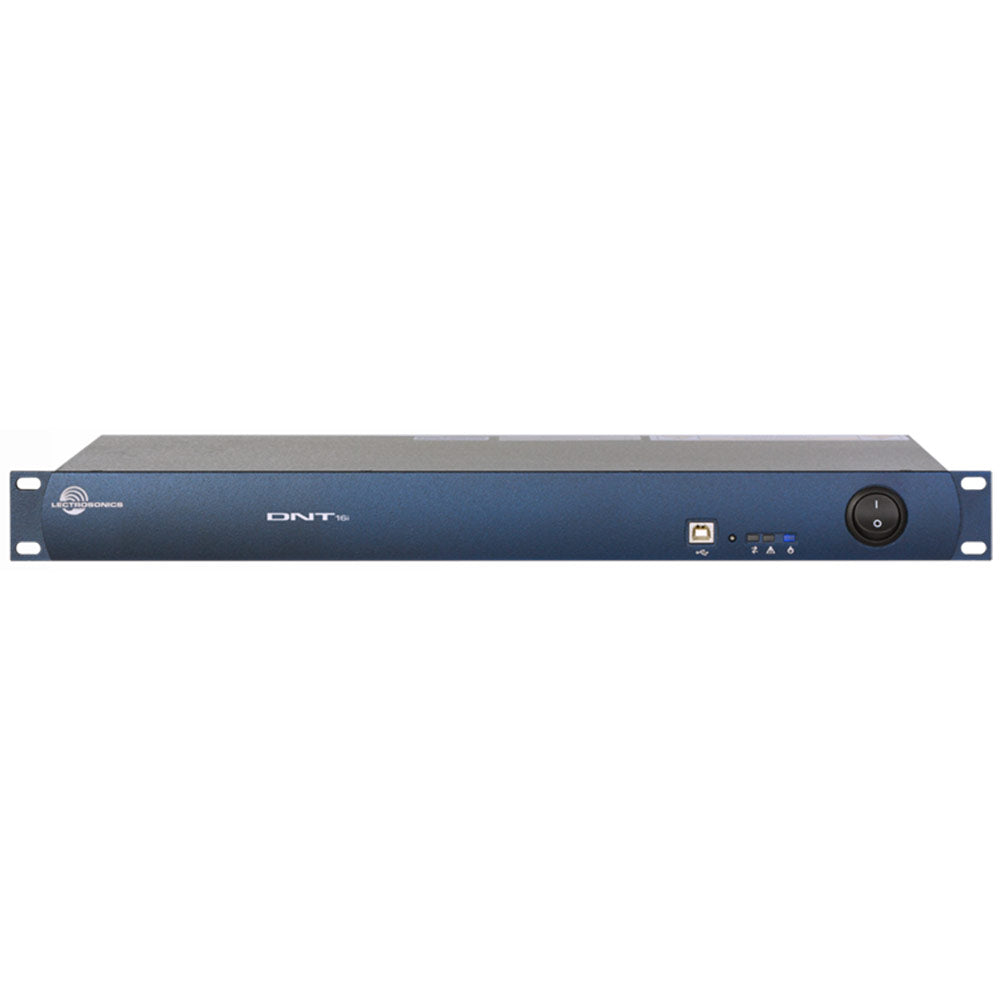


Lectrosonics DNT16i - 16-Input Dante Network Transport Interface
Availability:
Special Order ItemThis item is not stocked and needs to be ordered from the manufacturer. Please contact our sales team for more information.
Description
The DNT16i processor provides inputs into a Dante network from analog and digital signals. Each input provides extensive signal processing and routing to any one or all of 48 automatic mixers operating at the crosspoints of an internal digital matrix in the processor. The outputs of the matrix can be assigned to a Dante transmit channel and/or routed back to an input to be further mixed with another input or matrix mix.
Features:
- 16 mic/line analog inputs with 48V phantom power and wide range gain control
- 16 DanteTM digital inputs
- 32 DanteTM digital outputs
- Supports both switched and redundant modes in DanteTM operation
- Pre-mixing signal processing on all 32 inputs (analog and digital)
- 48 independent automatic mixers with 36 inputs per mixer and channel activity detectors
- Support for multi-level mixing: mixes can be looped back and used as mixer inputs
- Extensive signal processing including filters, delay and channel linking for dynamic processing (compressors, limiters)
- Gain smoothing to prevent transient noise during instantaneous level changes
- Four test signal generators available for system setup and testing
- Extensive macro command language
- Control interfaces via USB, RS-232, Ethernet and programmable logic I/O
- Rack mount or under table mount
DNT Series processors operate as native DanteTM devices to integrate analog and digital network signals in a seamless manner. Analog audio signals are converted to digital signals that are then processed and assigned to Dante network channels. Digital signals from the Dante network are processed in the same manner as analog signals, then sent back into the Dante network or converted to analog for mic/line outputs. The result is seamless integration of analog and digital audio signals into a common network where any signal assigned to a Dante transmit channel is then available at any receiving device connected to the network.
DNT Series processors operate as native DanteTM devices to integrate analog and digital network signals in a seamless manner. Analog audio signals are converted to digital signals that are then processed and assigned to Dante network channels. Digital signals from the Dante network are processed in the same manner as analog signals, then sent back into the Dante network or converted to analog for mic/line outputs. The result is seamless integration of analog and digital audio signals into a common network where any signal assigned to a Dante transmit channel is then available at any receiving device connected to the network.
| Audio inputs | Balanced mic/line level inputs with digitally programmable gain may be wired as unbalanced inputs. |
| Audio input channels | 32 total; 16 analog mic/line; 16 Dante digital |
| Max. input level | 20 dBu |
| Gain | Analog: 0 dB to 56 dB, programmable in 8 dB steps (the analog gain is automatically set by selecting the input gain) Digital [Dante]: -70 dB to +20 dB |
| Input impedance | 8 k differential mode, 2 k common mode |
| Phantom voltage | 48 V |
| Dynamic range | 102 dB |
| EIN | -127 dBu (20 Hz Ð 20 kHz, unweighted) |
| THD + noise | 0.01% |
| A-D Sampling Rate | 48 kHz; fixed |
| Audio outputs | Ê |
| Channels | 32 digital outputs delivered to the Dante network |
| Dante Interface | The interface provides dual RJ-45 connectors on the rear panel and an Ethernet switch built into the processor. |
| Supported sampling rate | 48 kHz |
| Data rate LED | 100Mbps/1Gbps |
| Activity LED | blinks when active |
| Modes of operation | Switched mode using either connector Redundant mode with primary and secondary networks using both connectors |
| Network Connectivity | Dante interface and Ethernet control can be connected to the same network |
| Filters | All filters have zero processing delay. |
| Tone control stages | 4 per input channel |
| ADFE | 8 per input channel; configurable as static or dynamic |
| Internal Signal Generator | Ê |
| Swept sine | Modes: single sweep, continuous sweep Waveforms: sawtooth (up or down), triangle Sweep rate: linear, logarithmic Parameters: start freq, stop freq, level [dBu], sweep time [sec] |
| White noise parameter | Level [dBu] |
| Pink noise parameter | Level [dBu] |
| Tone (sine wave) parameters | Level [dBu], frequency |
| Filter types | Ê |
| Low Pass | Butterworth (6, 12, 18, 24 dB/octave) Bessel (6, 12, 18, 24 dB/octave) Linkwitz-Riley (12, 24 dB/octave) Additional parameters: frequency [Hz] |
| High Pass | Butterworth (6, 12, 18, 24 dB/octave) Bessel (6, 12, 18, 24 dB/octave) Linkwitz-Riley (12, 24 dB/octave) Additional parameters: frequency [Hz] |
| Low Shelving | Butterworth (6, 12, 18, 24 dB/octave) Bessel (6, 12, 18, 24 dB/octave) Additional parameters: frequency [Hz] boost/cut [dB] |
| High Shelving | Butterworth (6, 12, 18, 24 dB/octave) Bessel (6, 12, 18, 24 dB/octave) Additional parameters: frequency [Hz] boost/cut [dB] |
| Peaking EQ (parametric) | Parameters: frequency [Hz] bandwidth [octave] boost/cut [dB] |
| Compressor | Soft knee with RMS level detector eliminates need for separate attack and delay settings; 0.1 ms increments, 1 second max.; continuously adjustable ratio |
| Power Requirements | 100-240 VAC, 50/60 Hz |
| Power Consumption | 20 W maximum |
| Dimensions | 1.75 x 19.00 x 7.70 inches |
| Weight | 5.32 lbs., 1.7 kg. |
The DNT16i processor provides inputs into a Dante network from analog and digital signals. Each input provides extensive signal processing and routing to any one or all of 48 automatic mixers operating at the crosspoints of an internal digital matrix in the processor. The outputs of the matrix can be assigned to a Dante transmit channel and/or routed back to an input to be further mixed with another input or matrix mix.
Features:
- 16 mic/line analog inputs with 48V phantom power and wide range gain control
- 16 DanteTM digital inputs
- 32 DanteTM digital outputs
- Supports both switched and redundant modes in DanteTM operation
- Pre-mixing signal processing on all 32 inputs (analog and digital)
- 48 independent automatic mixers with 36 inputs per mixer and channel activity detectors
- Support for multi-level mixing: mixes can be looped back and used as mixer inputs
- Extensive signal processing including filters, delay and channel linking for dynamic processing (compressors, limiters)
- Gain smoothing to prevent transient noise during instantaneous level changes
- Four test signal generators available for system setup and testing
- Extensive macro command language
- Control interfaces via USB, RS-232, Ethernet and programmable logic I/O
- Rack mount or under table mount
DNT Series processors operate as native DanteTM devices to integrate analog and digital network signals in a seamless manner. Analog audio signals are converted to digital signals that are then processed and assigned to Dante network channels. Digital signals from the Dante network are processed in the same manner as analog signals, then sent back into the Dante network or converted to analog for mic/line outputs. The result is seamless integration of analog and digital audio signals into a common network where any signal assigned to a Dante transmit channel is then available at any receiving device connected to the network.
DNT Series processors operate as native DanteTM devices to integrate analog and digital network signals in a seamless manner. Analog audio signals are converted to digital signals that are then processed and assigned to Dante network channels. Digital signals from the Dante network are processed in the same manner as analog signals, then sent back into the Dante network or converted to analog for mic/line outputs. The result is seamless integration of analog and digital audio signals into a common network where any signal assigned to a Dante transmit channel is then available at any receiving device connected to the network.
| Audio inputs | Balanced mic/line level inputs with digitally programmable gain may be wired as unbalanced inputs. |
| Audio input channels | 32 total; 16 analog mic/line; 16 Dante digital |
| Max. input level | 20 dBu |
| Gain | Analog: 0 dB to 56 dB, programmable in 8 dB steps (the analog gain is automatically set by selecting the input gain) Digital [Dante]: -70 dB to +20 dB |
| Input impedance | 8 k differential mode, 2 k common mode |
| Phantom voltage | 48 V |
| Dynamic range | 102 dB |
| EIN | -127 dBu (20 Hz Ð 20 kHz, unweighted) |
| THD + noise | 0.01% |
| A-D Sampling Rate | 48 kHz; fixed |
| Audio outputs | Ê |
| Channels | 32 digital outputs delivered to the Dante network |
| Dante Interface | The interface provides dual RJ-45 connectors on the rear panel and an Ethernet switch built into the processor. |
| Supported sampling rate | 48 kHz |
| Data rate LED | 100Mbps/1Gbps |
| Activity LED | blinks when active |
| Modes of operation | Switched mode using either connector Redundant mode with primary and secondary networks using both connectors |
| Network Connectivity | Dante interface and Ethernet control can be connected to the same network |
| Filters | All filters have zero processing delay. |
| Tone control stages | 4 per input channel |
| ADFE | 8 per input channel; configurable as static or dynamic |
| Internal Signal Generator | Ê |
| Swept sine | Modes: single sweep, continuous sweep Waveforms: sawtooth (up or down), triangle Sweep rate: linear, logarithmic Parameters: start freq, stop freq, level [dBu], sweep time [sec] |
| White noise parameter | Level [dBu] |
| Pink noise parameter | Level [dBu] |
| Tone (sine wave) parameters | Level [dBu], frequency |
| Filter types | Ê |
| Low Pass | Butterworth (6, 12, 18, 24 dB/octave) Bessel (6, 12, 18, 24 dB/octave) Linkwitz-Riley (12, 24 dB/octave) Additional parameters: frequency [Hz] |
| High Pass | Butterworth (6, 12, 18, 24 dB/octave) Bessel (6, 12, 18, 24 dB/octave) Linkwitz-Riley (12, 24 dB/octave) Additional parameters: frequency [Hz] |
| Low Shelving | Butterworth (6, 12, 18, 24 dB/octave) Bessel (6, 12, 18, 24 dB/octave) Additional parameters: frequency [Hz] boost/cut [dB] |
| High Shelving | Butterworth (6, 12, 18, 24 dB/octave) Bessel (6, 12, 18, 24 dB/octave) Additional parameters: frequency [Hz] boost/cut [dB] |
| Peaking EQ (parametric) | Parameters: frequency [Hz] bandwidth [octave] boost/cut [dB] |
| Compressor | Soft knee with RMS level detector eliminates need for separate attack and delay settings; 0.1 ms increments, 1 second max.; continuously adjustable ratio |
| Power Requirements | 100-240 VAC, 50/60 Hz |
| Power Consumption | 20 W maximum |
| Dimensions | 1.75 x 19.00 x 7.70 inches |
| Weight | 5.32 lbs., 1.7 kg. |
Your home for all things pro audio—backed by expertise and experience. Connect with us today.
Your home for all things pro audio—backed by expertise and experience. Connect with us today.